Clay Alternatives in 2026: An Honest Comparison From a Clay Solutions Partner
Last updated: 14 October 2026
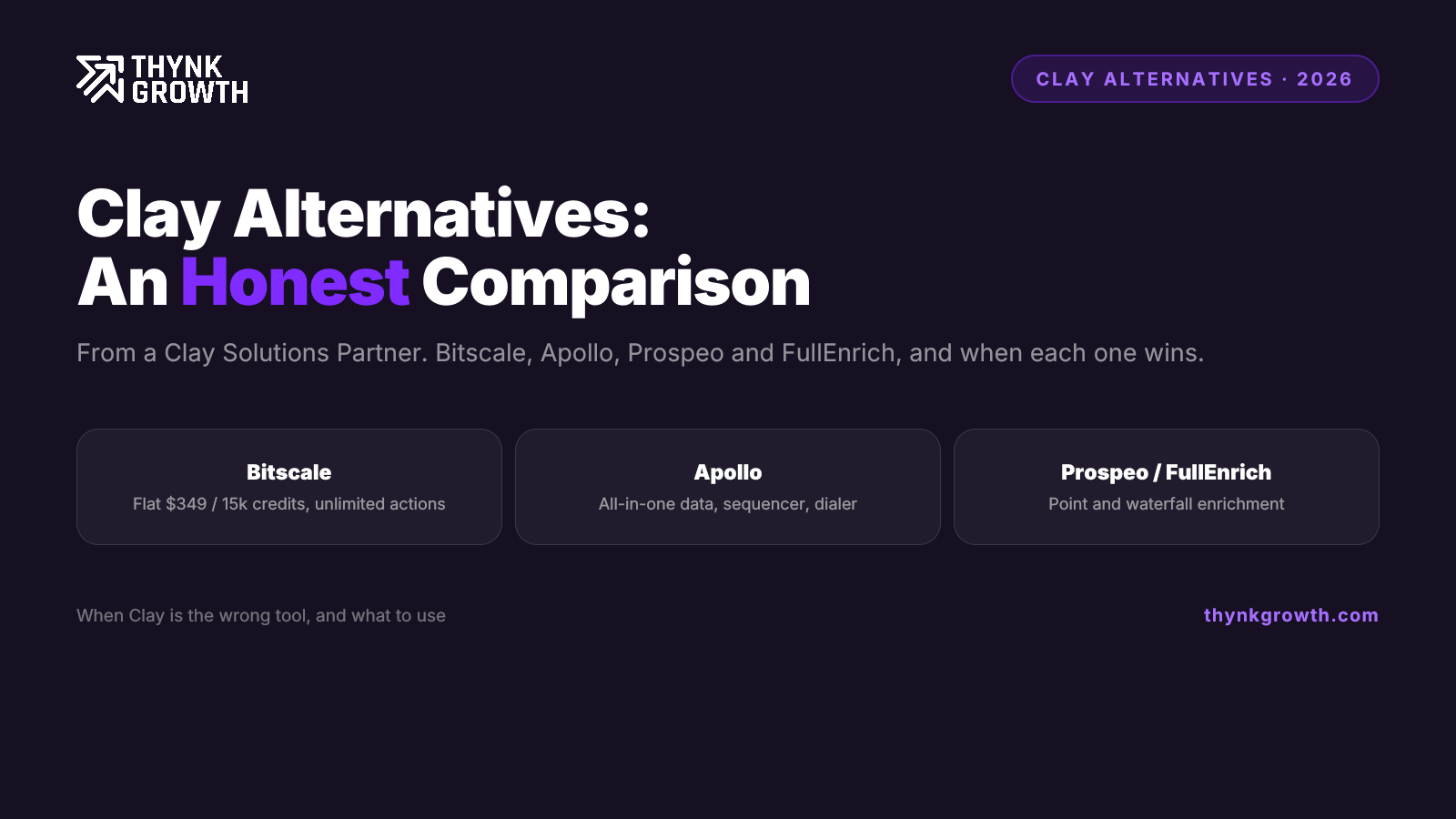
The best Clay alternatives in 2026 are Bitscale for cost and CRM sync, Apollo for one cheap all-in-one tool, and Prospeo or FullEnrich for plain enrichment. Clay is a GTM data platform that puts 200+ data providers, AI research and workflow automation into one spreadsheet-style workspace. None of the alternatives replicates all of it, so the right pick depends on how many steps each lead needs.
Faraz Ahmed, founder of ThynkGrowth, built and ran a $6.12M quarterly ABM pipeline engine as the sole Clay operator at an enterprise SaaS company, trained 70 BDRs on AI and Clay, and holds all four Clay certifications. ThynkGrowth is a Clay Solutions Partner that has coached 20+ GTM engineers and partnered with 20+ companies. That is why we can tell you where Clay is the wrong tool. Some links below are affiliate links, and we recommend what we would run ourselves.
Why do people look for Clay alternatives?
Most teams leave Clay for two reasons: metered cost and build complexity. Across its 2025 and 2026 pricing changes, Clay charges action credits on top of enrichment credits, so every workflow step meters. Complex tables also need a trained operator, which is a real hiring or training cost. Training that operator is exactly what our cohort programme, ThynkCrew, is built to do.
Clay is not weak. It offers Claygent AI research, Clay Signals (job changes, promotions, funding, hiring and tech-stack changes), a native Sequencer, Audiences, ad syncing and an Agent and MCP layer. Clay reports $100M+ in ARR, 500,000+ GTM teams and a roughly $5B valuation, and its published customer stories include Anthropic reaching 3x enrichment coverage and Intercom growing outbound pipeline by 140%.
The problem is fit. A team that needs email and phone data for a list does not need an orchestration engine, and pays for one anyway.
How do Clay, Bitscale and Apollo compare on cost?
Bitscale is usually the cheapest for heavy, multi-step work because it charges a flat $349 for 15,000 credits with unlimited actions, so extra workflow steps add nothing. Clay charges enrichment credits plus an action credit for every step, so its bill scales with how many steps each row runs. Apollo bundles data, sequencing and calling into a per-seat subscription, so its cost scales with headcount rather than steps.
The useful way to think about it is the shape of the bill, not a single sticker price. On Bitscale, because actions are unlimited, a ten-step table costs the same as a one-step table. On Clay, each extra step in a large table adds one action credit per row, so a 10,000-row table pays another 10,000 credits every time you add a column. If your workflow is short, that difference barely shows. If it is long and run at volume, it is the whole decision.
When is Bitscale a better choice than Clay?
Bitscale wins when you run long, multi-step workflows at volume, or when your CRM is your source of truth. Its flat $349 for 15,000 credits with unlimited actions means complexity stops costing money, and it is CRM-native, with two-way HubSpot and Salesforce sync.
Bitscale states waterfall coverage of 90%+ for emails and 95%+ for mobiles, with bounce under 0.5% across 100+ providers. Those are vendor figures, so test them on your own list before committing. Where Bitscale loses is ecosystem: Clay has more providers (200+), a larger community and more templates. Our full breakdown is in Clay vs Bitscale, and you can trial Bitscale directly.
When does Apollo beat Clay?
Apollo beats Clay when you want one cheap tool for data, sequencing and calling, and your process is simple. It combines a B2B database, a native sequencer and a dialer, so a small team can prospect and send from one login without building anything.
The tradeoff is depth. Apollo's data is cheaper, but its orchestration and signal capabilities are weaker than Clay's. You cannot chain waterfall providers, run bespoke AI research per account or build multi-signal triggers with the same flexibility. Expect to hit a ceiling once your targeting needs conditional logic. For solo founders and early BDR teams, Apollo is often the sensible start, and we compare the two in detail in Clay vs Apollo.
Are Prospeo and FullEnrich worth using instead of Clay?
Prospeo and FullEnrich are worth using when your only job is finding verified contact data. Both are point or waterfall enrichment tools without orchestration: you send a name and domain in, and an email or mobile comes out. There is no table logic, AI research or sequencing.
That simplicity is the appeal. It costs less to learn, slots into an existing stack through an API or CSV, and avoids paying for steps you do not use. We use Prospeo for job-change detection with verified contact data in a single step, and FullEnrich is a strong waterfall for emails and mobiles. The limit is obvious: you still need somewhere to build the workflow. Our best email finder tools guide ranks them side by side.
When is Clay still the right choice, and which alternative should you pick?
Pick Clay when each lead needs several data sources, AI research and signal logic before it reaches a sequence. Pick Bitscale for high-volume, CRM-centred work, Apollo for a cheap single-tool start, and Prospeo or FullEnrich when you only need contact data. Clay is the wrong fit when your workflow is two steps long.
The honest rule: if your table has only one or two enrichment steps, you are paying for orchestration you do not use. If it has many, Clay's flexibility usually earns its cost, provided someone competent operates it. Complexity is the hidden bill, and an under-skilled operator burns credits quickly.
If you want to learn Clay properly, ThynkCrew is our cohort-based GTM engineering coaching programme: 8 weeks, 12 live sessions and 20 seats, built on Clay and certified on assessment. Crew 01 starts on 14 November 2026. If you would rather not build it yourself, our done-for-you outbound service runs the stack for you, whichever tool fits.
What are the best Clay alternatives in 2026?
The strongest options are Bitscale for cost and CRM sync, Apollo for an all-in-one database and sequencer, and Prospeo or FullEnrich for point enrichment. Each covers part of what Clay does. None matches Clay's full orchestration, signals and AI research in one workspace.
Is Bitscale cheaper than Clay?
For multi-step workflows at volume, usually yes, because Bitscale charges a flat $349 for 15,000 credits with unlimited actions while Clay meters every step. For a simple one-step lookup the gap narrows, so model your own step count before deciding.
Is Apollo a good Clay alternative?
Apollo is a good alternative for teams that want data, sequencing and dialling in one inexpensive tool. It is weaker on orchestration and signals, so it suits simple processes better than complex, signal-led ones.
When should you not use Clay?
Avoid Clay if your workflow is only a few steps long, you have no one to operate it, or you only need verified emails and phones. In those cases a point enrichment tool or Bitscale will cost less and take less effort.
Want this running for your pipeline?
Book a free strategy call. We map your outbound plan whether you work with us or not.
Book a free strategy call